
DIY vs Professional Locksmith
DIY vs Locksmith in Singapore: When to Fix Your Own Locks and When to Call a Pro
Balancing cost, safety, and skill: knowing when a quick DIY lock repair is enough, and when only a locksmith’s expertise will keep your home secure.
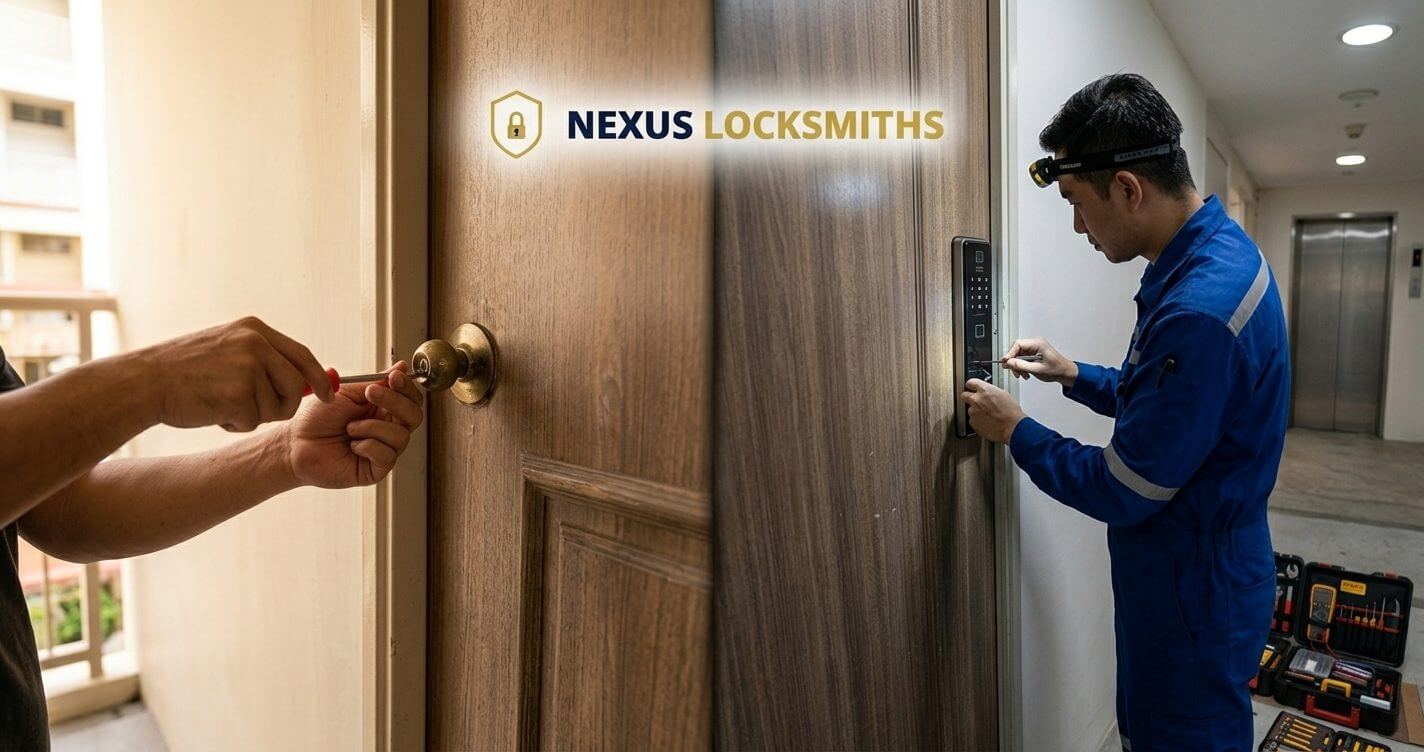
Safe DIY lock repair covers tightening loose screws, lubricating a stiff cylinder, replacing digital lock batteries, and adjusting strike plate alignment. Call a licensed locksmith for broken keys, jammed or seized locks, someone trapped inside a room, sagging or warped doors, digital lock faults, and any full lock replacement. The dividing line is simple. If a mistake could lock a person in, damage the door, or leave your home less secure than before, it is a job for a professional, not a DIY lock repair.
A Real Case: Two Leftover Screws and a Trapped Daughter
A customer called us frantically on a Thursday afternoon. She and her husband had just moved back to Singapore and were doing up an apartment that had, until recently, been rented out. Her father offered to change the old bedroom door locks. He had retired a few years earlier and spent quite a bit of time watching YouTube videos on DIY and home improvement. He brought his Ikea toolkit to the house, along with a few doorknob locks he had bought at a hardware store.
When he had finished installing the first door lock, he found that there were two screws left over. Thinking nothing of it, he invited his daughter to enter her master bedroom to test the lock. She thanked him and stepped into the room, and he closed the door, then turned the doorknob. Nothing. The door remained shut.
“Ok, stop joking around. Open the door,” his daughter said.
“I’m not joking. I can’t open the door,” her father replied.
The customer called her husband, and both her father and her husband tried to open the door without success. They then called our team to assist.
We checked the lock and found that the two screws the father had thrown away were actually part of the lock mechanism that connected the handle to the latch. Without the screws, the mechanism could not retract the latch. As there was no way to access the latch, we checked with the customer before removing the lock to open the door and free her.
She was a little red in the face and suggested that her father let us install the rest of the door locks.
Part 1: The Case for DIY: Lock Repairs You Can Safely Do Yourself
The above incident happens more often than you might think. There are a great many Facebook groups, internet forums, and online videos about self-repair and home maintenance, and about half of them contain useful advice from industry professionals, security companies, or lock brands. Many more, however, are published by content creators who present information in an entertaining manner, but may lack the industry experience or correct techniques to install or repair locks safely and effectively.
We do encourage customers to play their part in maintaining their locks. The DIY lock repair and maintenance jobs below are low-risk, need only basic tools, and rarely go wrong:
- Tightening visibly loose screws on handles, hinges, and strike plates.
- Replacing digital lock batteries before they run flat. Most digital locks warn you for days or weeks first.
- Cleaning the keyway and lock face with a dry cloth to clear dust and grit.
- Lubricating a stiff cylinder with a dry graphite or PTFE-based lubricant made for locks.
- Testing your doors periodically, opening and closing each one to note any rubbing, dragging, or sticking.
Do note, though, that overtightening a lock can restrict its movement and cause it to jam. Snug is enough. If a screw will not bite, the timber around it has likely worn. Forcing it will only widen the hole.
If your digital lock is behaving oddly rather than simply flat, our guide on digital lock problems and how to fix them covers what you can reset yourself and what needs servicing.
Part 2: When to Call a Locksmith, and Why DIY Backfires
Some situations look like a five-minute fix on video and turn into a broken door in real life. These are jobs we are called out to repair regularly, after the DIY attempt.
The credit card trick
We have encountered situations where customers shoved a credit card into the door gap to try to move a door latch, only for the card to break, leaving pieces wedged tightly between the door and the frame and making the lock even harder to free. What would have been a straightforward non-destructive opening becomes a longer, more expensive job.
Superglue on a broken key
On another occasion, we came across a customer who had watched a video on using superglue to mend a broken key. He inserted the sticky key into the keyhole, and some of the glue got onto the lock’s internals, glueing the mechanism together. As it could no longer move, we had to break and remove the lock to open the door. A broken key extracted professionally usually leaves the lock intact; a glued one almost never does.

Kicking the door down
You may also have seen characters on television or in films kick doors down. This does not work. Although a door may seem fairly weak, we have met customers who have injured their feet and legs trying to kick one open. In some cases, they have twisted an ankle or fallen and hurt themselves. What’s more, replacing a broken door costs significantly more than engaging a locksmith.
Hitting the lock with a hammer
One suggestion we have seen in a social media group involves using a hammer to hit a lock. Hammering a lock will not unlock it, nor will it free a jammed one. Here is what is likely to happen: you miss the lock and put a hole in the door instead, or you hit the lock, and it bounces off and hits you (hopefully not in the face). When wielding a hammer with great force, there is also a risk that your grip slips and you drop the hammer on your foot.
The door itself is often the real problem
We were once called to a flat where a worker had installed an older-style lock, closed the door, and could not reopen it. The lock had to be broken off. The lock was not the fault. The door was sagging, and slight warping caused the frame to bite onto the latch so it could not release.
This is why we assess the door before fitting any lock: we check door gaps, hinge condition, and whether the door opens and closes smoothly, and we carry out door adjustment or repair before installation. A perfectly good lock fitted to a misaligned door could fail and jam the lock and door, potentially trapping someone in the room. This kind of assessment is part of our lock care and secure access work.
Replacement locks are rarely a like-for-like swap
Modern locks are not exact replacements for locks installed ten years ago. Backsets, spindle sizes, and screw positions differ between generations and brands, and thicker doors often need longer specialised fasteners or adaptors that do not come in the retail box.
We generally recommend buying locks from established local suppliers, as replacement parts and key blanks are far easier to obtain. With some imported locks, local suppliers may not stock the right key blanks or be able to cut duplicate keys at all, and non-standard fittings can leave you stuck when a part fails. If you are choosing a new lock, our guide on how to choose the best digital lock for your home walks through what to check before you buy.
Someone is locked inside
Being trapped in a room with no way out is genuinely stressful, especially for a child or an elderly family member. Opening the door may require dismantling the lock, manually pulling the deadbolt or latch clear of the frame, or in rare cases cutting into the door to clear an obstruction. If someone is shouting or crying inside, the pressure on everyone outside grows quickly. This is an emergency access situation, so call immediately rather than experimenting.
DIY or Locksmith? A Quick Decision Table
| Situation | DIY or Pro? | Why |
|---|---|---|
| Loose handle or hinge screws | DIY | Simple, low risk, needs one screwdriver |
| Flat digital lock batteries | DIY | Designed for user replacement |
| Stiff key, dusty keyway | DIY | Dry lubricant and a clean cloth usually solve it |
| Latch just catching the strike plate | DIY (minor) | Small adjustment; stop if the door is sagging |
| Key snapped in the lock | Pro | Extraction tools needed; glue or pliers destroy the cylinder |
| Lock jammed or seized | Pro | Force converts a repair into a replacement |
| Person locked inside a room | Pro (urgent) | Safety first, and access is often non-obvious |
| Door sagging, warped, or dragging | Pro | The door must be corrected before the lock |
| Digital lock faults, failed fingerprint or PIN | Pro | Diagnostics and brand-specific spare parts |
| New lock installation or full replacement | Pro | Alignment, sizing, and security grade all matter |
| Lost keys or a tenant moving out | Pro | Rekeying or replacement to restore security |
| Locked out of your car | Pro | Specialised tools avoid scratching or damaging trim |
Part 3: Making the Smart Choice
While there is value in taking the initiative to build up your handyman skills, there is also wisdom in focusing on tasks that are relatively easy to perform and have a high chance of success, and in calling on the professionals for more complex lock needs.
Before you start any DIY lock repair, run through four questions:
- Cost: will a failed attempt cost more than the call-out? A damaged door usually does.
- Safety: could anyone end up trapped, or could you injure yourself?
- Skill and tools: do you have the right tools, or just the ones you happen to own?
- Urgency: is anyone waiting outside, inside, or late for something? Urgency makes mistakes more likely.
If you are unsure, send us a photo of the lock. We can often tell you in a message whether it is a five-minute fix you can manage yourself.
Locks may seem simple, but they guard what matters most. A loose screw or a misaligned latch can be a quick DIY fix, saving you time and money. But when the problem threatens your safety or requires specialised tools, calling a locksmith is the smarter choice. The bottom line: handle the small stuff yourself, and trust the professionals when security is on the line, so your home stays protected without unnecessary risk.
Frequently Asked Questions
Can I install a door lock myself in Singapore?
You can, but success depends on the door as much as the lock. Modern locks are not exact replacements for older ones, and thicker doors often need specialised fasteners. If the door sags, drags, or has been adjusted before, have it assessed first, because a lock fitted to a misaligned door will jam.
What should I do if my key breaks in the lock?
Stop and call a locksmith. Do not use glue, pliers, or another key to push the broken piece further in. A professional extraction usually saves the existing lock; a DIY attempt often destroys it and turns a small job into a full replacement.
Is it safe to open a door with a credit card or ATM card?
Not recommended. It requires skill and experience to do it well. Unless you are experienced, there is a chance that the card may break into pieces while inserted into the door gap. Broken card fragments can increase the complexity of the jam, making the eventual opening harder and more costly.
How do I know whether my lock is jammed or my door is the problem?
If the lock turns freely when the door is open but is non-responsive when the door is closed, the door or frame is almost certainly at fault, usually from door sagging or wood warping. That needs door adjustment, not a new lock.
How much does a locksmith cost in Singapore?
Nexus Locksmiths quotes upfront before any work begins, based on the tools, materials, and time the job requires. A typical job starts from around $60, plus a transport charge depending on distance. See our rates and FAQ for details.
How quickly can a locksmith arrive?
We typically arrive within 20 to 40 minutes across Western and Central Singapore, and we give an honest ETA based on real-time traffic. You can read what happens when you call an emergency locksmith to know what to expect.
Can I fix a digital lock myself?
Replacing batteries and re-entering a PIN are user-level tasks. Failed fingerprint readers, error tones, dead panels, and motor faults need diagnosis and brand-specific parts. See our digital lock access service.
Get Help With Your Lock Needs
For advice or to get help with your lock needs, please call or WhatsApp Nexus Locksmiths at 8758 2418. More than 500 satisfied customers have left us top reviews on Google Business. We look forward to helping you with your lock needs.
Nexus Locksmiths is a Singapore-registered and insured locksmith with hands-on experience across HDB flats, condominiums, landed homes, offices, and vehicles. Learn more about our team, or explore our emergency access, digital lock, vehicle access, and lock care services.
Handle the small stuff yourself — call us for everything else.
Registered, insured, and available around the clock across Western, Northern, and Central Singapore.